
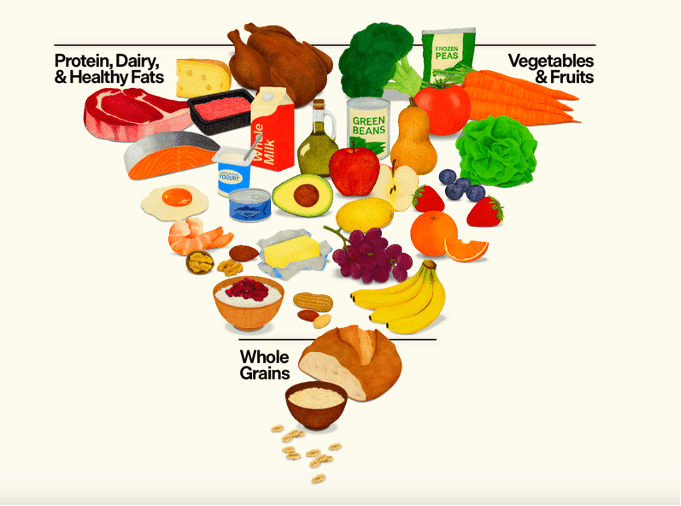
The U.S. Departments of Agriculture (USDA) and Health and Human Services (HHS) released the 2025–2030 Dietary Guidelines for Americans — the nation’s federal nutrition advice, updated every five years.1 For the first time in history, the Guidelines align with current nutritional science and represent the most sweeping overhaul of dietary guidance in decades. The focus now is on whole foods and real-world eating patterns that aim to curb chronic disease and improve health.
The Message is Simple: “Eat Real Food”
The updated message stresses protein targets, limits sugar, warns of the dangers of processed food, and even inverts the shape of the classic food pyramid. There is also a direct emphasis on avoiding “highly processed” foods — packaged, prepared meals, and ready-to-eat snacks laden with refined carbohydrates, added sugars, and industrial additives.
According to the U.S. Department of Health and Human Services, “We are putting real food back at the center of the American diet. Real food that nourishes the body. Real food that restores health. Real food that fuels energy and encourages movement and exercise. Real food that builds strength.”2 These guidelines provide the foundation for making America healthy again and call on farmers, ranchers, health care professionals, educators, community leaders, insurers, and lawmakers to support this effort. Here is a brief review of what’s new, what changed, and what matters.
Flexible Guidance Rooted in Modern Nutrition
The new guidelines are simple, flexible, and backed by current nutritional science.
- Eat the right amount for you. The calories you need depend on your age, sex, height, weight, and physical activity level. Pay attention to portion sizes, particularly for higher-calorie foods and beverages. Hydration is a key factor in overall health. Choose water (still or sparkling) and unsweetened beverages to support hydration.
- Whole foods take center stage. The strongest message of the 2026 Guidelines is a clear shift away from ultra-processed foods and toward eating foods closer to their natural form — vegetables, fruits, whole grains, quality proteins, and healthy fats. The focus on grains has shifted toward a lower intake of unprocessed whole grains and a sharp reduction in refined carbohydrates.
- Processing matters more than calories. Rather than focusing only on calorie counts or macronutrient percentages, the Guidelines now emphasize how food is made. Highly processed foods are directly linked to increased risk of obesity, diabetes, and heart disease.3
- The protein recommendations are higher. Prioritize protein at every meal. Consume 1.2 to 1.6 grams of protein per kilogram of body weight from both animal and plant sources. This is a significant rise from the longstanding benchmark of about 0.8 grams/kg. Protein needs are increased to better support muscle mass, metabolic health, blood sugar stability, and healthy aging.
- Incorporate healthy fats from whole foods. This includes meats, seafood, eggs, nuts, seeds, olives, and avocados. Consume full-fat, minimally processed dairy with no added sugars (low-fat and fat-free dairy are no longer the default recommendation). Whole milk, yogurt, and cheese are now considered compatible with healthy eating patterns when consumed in appropriate portions. At the same time, limits on saturated fats remain in place — no more than 10% of daily calories — though the document suggests that whole-food sources of saturated fat (like meats or dairy) fit into healthy patterns better than isolated sources.
- Limit highly processed foods, added sugars, and artificial additives. The added sugar guidance is stronger and clearly identified as non-essential. The Guidelines encourage keeping added sugars extremely low and minimizing sugary beverages, desserts, and packaged snacks.
- Limit alcohol consumption for better overall health. The numeric limits of past editions (e.g., one drink per day for women, two for men) have been removed and replaced by a simpler directive to “consume less alcohol for better health,” especially for pregnant women and those with alcohol use concerns.
The Guidelines also provide tailored recommendations for infants and children, adolescents, pregnant and lactating women, older adults, individuals with chronic disease, and vegetarians and vegans, ensuring nutritional adequacy across every stage of life.
Sanoviv Side Notes
Even with improvements, the Guidelines are still designed for the “average American” — a person who doesn’t truly exist in modern health care. Sanoviv practitioners work with individuals who have:
- Blood sugar disorders and insulin resistance
- Thyroid dysfunction
- Autoimmune disease
- Gut disorders
- Cancer
- Lyme disease
- Genetic differences in detoxification and metabolism
What works for one person may worsen symptoms in another, as the Guidelines cannot account for metabolic individuality. Sanoviv takes nutrition a step further and provides customization based on health conditions, laboratory tests, food sensitivities, budget, ancestral heritage, accessibility, and food preferences.
The 2026 Guidelines are a Welcome Change
Ultimately, the 2026 Dietary Guidelines for Americans represent a welcome and meaningful step forward. These guidelines shape far more than personal food choices —influencing school lunch programs, hospital meals, military and veteran nutrition, correctional facilities, childcare centers, food assistance programs, and public health policy nationwide. Even small improvements can have a profound ripple effect. A stronger emphasis on real, minimally processed foods could improve energy, learning, resilience, and long-term health for millions of Americans who rely on institutional meals every day.
While no set of national guidelines can address individual needs, this evolution signals an important shift: one that recognizes food not merely as fuel, but as a foundational pillar of health, dignity, and well-being. If implemented thoughtfully, these changes may help nourish not only bodies but the future of public health itself.
REFERENCES
- USDA Food and Nutrition Service, Kennedy, Rollins Unveil Historic Reset of U.S. Nutrition Policy, Put Real Food Back at Center of Health, January 2026
- U.S. Dietary Guidelines for Americans, 2025-2030
- Monteiro CA, Louzada ML, Steele-Martinez E, Cannon G, Andrade GC, Baker P, Bes-Rastrollo M, Bonaccio M, Gearhardt AN, Khandpur N, Kolby M, Levy RB, Machado PP, Moubarac JC, Rezende LFM, Rivera JA, Scrinis G, Srour B, Swinburn B, Touvier M. Ultra-processed foods and human health: the main thesis and the evidence. Lancet. 2025 Dec 6;406(10520):2667-2684.